

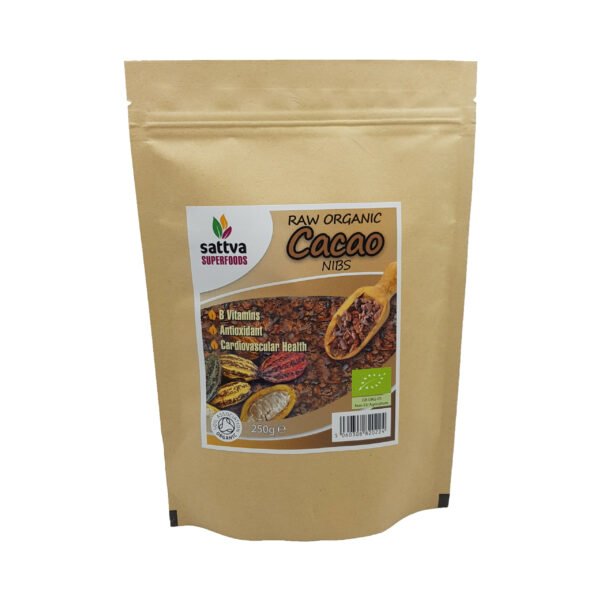
Cocoa nibs are chocolate before civilisation got involved: whole raw cacao beans, crumbled into crunchy fragments and left exactly there — no sugar, no conching, no compromise. Sattva Superfoods sources the Criollo variety, the aristocrat of cacao’s family tree, organic from Peru, 250 g to the pack.
Why Criollo matters
Cacao has its grape-variety politics, and Criollo is its rarest fine-flavour cultivar — a small fraction of world production, prized for complexity and low bitterness where bulk varieties trade on volume. In nib form the difference is unhideable: these eat fruity, winey and deeply chocolatey rather than merely bitter, which is why Criollo nibs convert people who bounced off supermarket nibs before.
What nibs bring nutritionally
Nibs are the whole bean, so they carry cacao’s famous natural portfolio: polyphenols and flavonoids, theobromine (cacao’s gentle signature stimulant), plus minerals the bean is genuinely rich in — magnesium, potassium, copper and iron among them. That’s the whole-food statement, offered without the miracle-claims garnish: dark chocolate’s raw material, intact.
How to use them
- Where chocolate chips go — cookies, muffins, banana bread; nibs hold their crunch where chips melt to sweetness
- Breakfast texture — over porridge, yoghurt and smoothie bowls with granola’s confidence
- Trail mix — with nuts and dried fruit, where their bitterness balances the sweetness
- Blended — into smoothies for chocolate depth without sugar
- The espresso trick — a few nibs chewed alongside coffee; the pairing explains itself
An honest word on flavour
Nibs are unsweetened by definition — closer to 100% chocolate than to any snack aisle resident. First-timers should meet them in company (yoghurt, dates, banana) rather than solo from the bag; converts eventually eat them by the handful and call everything else too sweet. Both stages are traditional.
Frequently asked questions
Cacao vs cocoa — which is right? Same bean, two spellings — “cacao” leans raw-tradition, “cocoa” leans everyday English; the pack answers to both.
Caffeine content? Cacao’s stimulant is mostly theobromine — gentler and slower than coffee’s caffeine; evening porridge survives a sprinkle.
Storage? Sealed, cool and dry — nibs keep their crunch for many months treated like the good coffee beans they resemble.
From pod to pack
Every nib in this pack started as a seed inside a cacao pod on a Peruvian tree. After harvest the beans are fermented — the step where cacao’s flavour actually develops, as natural yeasts work through the pulp — then dried in the sun, cracked, and winnowed so the papery shell blows away. What remains is crumbled into nibs and packed. That is the entire process: no roasting to high temperatures, no alkalising, no additives, which is why raw-food tradition treats nibs as the reference form of cacao. Chocolate manufacture takes these same nibs and grinds, sweetens and moulds them; skipping those steps is precisely the point here.
Three easy recipes to start
Two-minute bark: melt dark chocolate, stir in a generous handful of nibs, spread thin on baking paper, chill and snap. The doubled cacao makes ordinary bark taste expensive. Energy balls: blitz dates, oats and nut butter, work in nibs at the end so they stay whole, and roll. Nib-crusted banana: halve a banana lengthways, press the cut face into nibs, and eat it as the fastest respectable dessert in the repertoire. Each recipe survives improvisation — nibs are forgiving company.
Pairing notes
Cocoa nibs keep excellent company: sea salt sharpens them, orange zest flatters them, and a drizzle of honey converts sceptics on the spot. In savoury territory, a scatter over a mole-style stew or a beetroot salad borrows a trick Mexican and modern-bistro kitchens have both proven — cacao’s bitterness reads as depth once it leaves the dessert course.
Delivery in Malta & Gozo
€6 delivery, free over €40 across Malta and Gozo, or collection from St Paul’s Bay.






Reviews
There are no reviews yet.