

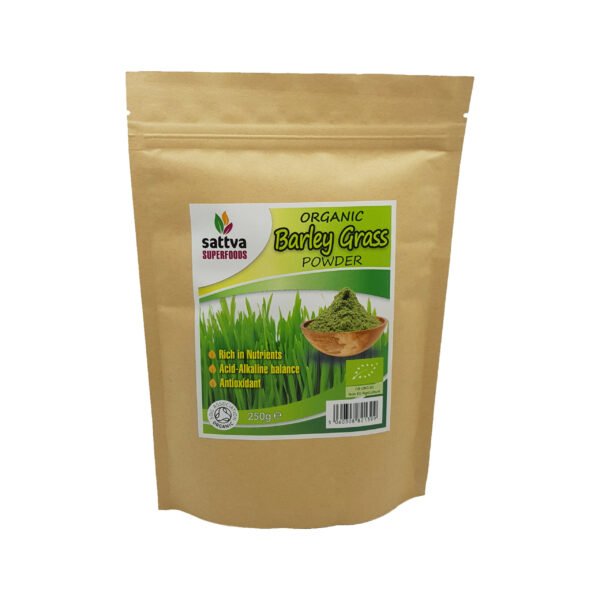
Barley grass is the young leaf of the barley plant, harvested green before any grain forms and dried into one of the green-powder tradition’s founding foods — the original “green drink” of 1980s health culture, decades before the smoothie bowl. Sattva Superfoods’ barley grass is certified organic, single-ingredient, grown in the EU and milled from the whole young leaf, 250 g to the resealable pouch.
What the young leaf carries
Cut in its brief green youth, the barley leaf holds a naturally broad spread of micronutrients: potassium, calcium, magnesium, iron, copper, phosphorus, manganese and zinc among the minerals, with beta-carotene, vitamin C, folic acid, pantothenic acid and the B vitamins alongside — plus the chlorophyll that makes the powder unmistakably, deeply green. The gram-for-gram comparisons the category loves (“more vitamin C than oranges”) describe the concentrated dried leaf against fresh foods, so the honest framing is the simple one: a teaspoon of barley grass is a genuinely dense little serving of green nutrition, best understood as a supporting player in a varied diet rather than a substitute for one.
Barley grass vs wheat grass
The two young cereal grasses are siblings with distinct temperaments: barley grass is the milder, sweeter, more soluble of the pair — commonly rated the beginner-friendly green — while wheat grass runs grassier and more assertive. Their nutrient emphases differ enough that rotation is the juice-bar convention; many of our customers keep both pouches and alternate mornings.
How to use it
- The green glass — a teaspoon whisked into water or apple juice with a squeeze of lemon; barley grass dissolves more willingly than most greens
- Smoothies — with banana, cucumber and mint for the fresh-green profile, or mango for camouflage
- Juices — stirred into fresh vegetable or citrus juice, its traditional home
- Salad dressings — half a teaspoon whisked into a lemony vinaigrette turns it herb-green
An honest word on flavour
Barley grass tastes green but gently so — sweet grass with a faint spinach note, noticeably kinder than wheat grass or spirulina. Most people manage it in plain water within the first week, which cannot be said of every pouch on this shelf. Start with half a teaspoon and let the habit build itself.
Frequently asked questions
Does barley grass contain gluten? The grass is cut before grain — and its gluten — develops; anyone coeliac should still be guided by the printed label as the final word.
How much per day? A teaspoon is the customary serving; the 250 g pouch holds months of green mornings.
Storage? Cool, dark and tightly resealed — green powders fade in sunlight like the leaves they were.
The green-drink original
Barley grass has a serious claim to founding the entire green-powder category: the Japanese research and juicing culture of the mid-twentieth century that popularised “green barley essence” is where the modern aisle began, years before wheat grass shots reached the West or spirulina left the health-food fringe. The powder in this pouch is the direct descendant of that tradition — the whole young EU-grown leaf, dried and milled, rather than a juice extract — and it remains the green most nutritionists suggest first precisely because it asks the least of the palate.
A week-one plan for new greens drinkers
Day one: half a teaspoon in apple juice, stirred hard, drunk cold — barely noticeable. By day four, move to a full teaspoon in water with lemon. By the weekend, try the proper green smoothie: banana, spinach, cucumber, a teaspoon of barley grass, cold water and ice. That gentle ladder builds the habit that matters more than any single serving, and barley grass’s mildness is what makes the ladder climbable — which is exactly why it belongs first on the shelf and first in the glass.
Delivery in Malta & Gozo
€6 delivery, free over €40 across Malta and Gozo, or collection from St Paul’s Bay.

Reviews
There are no reviews yet.