
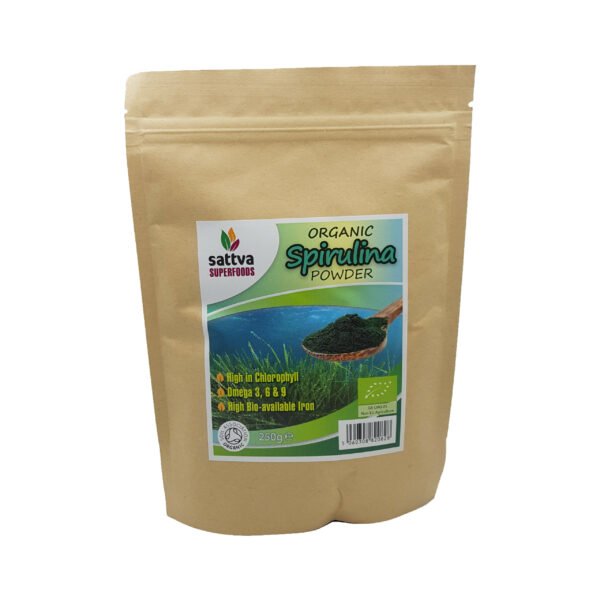
Sattva Superfoods – Spirulina Powder 250 g
€16.99
Organic spirulina powder — a nutrient-dense blue-green algae.
- Naturally rich in protein and nutrients
- Blend into smoothies and juices
- 250 g resealable pack
20 in stock
- Fast Malta & Gozo delivery — free over €40
- 14-day returns on unopened items
- Secure SSL checkout
Spirulina is the blue-green algae that turned “superfood” from marketing into a category — a microscopic freshwater organism cultivated for its extraordinary nutritional density, dried into the deepest green powder in the kitchen. Sattva Superfoods’ spirulina is certified organic, a single ingredient, and packed in the UK in a 250 g resealable pouch.
What spirulina actually is
Technically a cyanobacterium rather than a plant, spirulina has been eaten for centuries — the Aztecs harvested it from Lake Texcoco as tecuitlatl, and communities around Lake Chad have pressed it into dihé cakes for generations. Modern cultivation grows it in controlled alkaline ponds, where its spiral filaments (the name means “little spiral”) are harvested, rinsed and gently dried to keep the pigments and nutrients intact.
The nutritional headline
Spirulina’s fame rests on numbers few whole foods approach: it is around 60% complete protein by dry weight — containing all essential amino acids — and carries iron, B vitamins, beta-carotene and its signature pigment phycocyanin, the blue in blue-green. That density is why a mere teaspoon turns an entire smoothie jungle-green and why NASA studied it as a compact food for space missions. We state the composition and leave it there: this is a concentrated whole food, not a medicine.
How to use it
- Smoothies — the standard home: banana, pineapple or mango carry it best; start with half a teaspoon
- Juices — stirred into citrus, where acidity brightens the flavour considerably
- Energy balls and raw bars — a teaspoon kneaded into date-and-nut mixtures disappears completely
- Blue-green lattes and bowls — the Instagram genre exists because of this powder; a little colours everything
- Savoury sprinkles — over popcorn or avocado toast with lemon and salt, for the committed
An honest word on flavour
Spirulina tastes of the sea and the pond at once — briny, green, slightly sulphurous neat. Nobody pretends otherwise. In a fruit smoothie at sensible doses it vanishes; solo in water it is an acquired taste mostly left unacquired. Buy it for the nutrition, dose it for the flavour.
Frequently asked questions
Spirulina or chlorella? Cousins with different characters — spirulina is higher in protein and easier to digest raw; chlorella is a true green algae with a cracked cell wall. Many users rotate both.
How much per day? A teaspoon (roughly 3–5 g) is the customary culinary serving; the pouch holds a couple of months at that pace.
Storage? Cool, dry, tightly resealed and out of sunlight — the pigments that make it vivid are light-sensitive.
From Aztec harvest to modern pond
The continuity is worth pausing on: sixteenth-century Spanish chroniclers described harvesters skimming blue-green cakes from Lake Texcoco with fine nets, and satellite-era agronomists grow the same organism in raceway ponds because nothing else packs protein into so little space and water. Spirulina produces more protein per hectare than any conventional crop, needs no arable land, and thrives in alkaline water most life avoids — the reasons international development programmes and space agencies keep returning to it. Buying a pouch of the organic powder connects a Maltese kitchen to one of the oldest continuously eaten foods on record.
Getting the dose and pairing right
Start smaller than you think — half a teaspoon in a thick fruit smoothie, ideally one with banana and pineapple, whose sweetness and acidity flatter the algae completely. Build to a full teaspoon over a week or two as the flavour becomes familiar. Lemon juice is spirulina’s best friend in a plain glass of water for those who prefer it fast and functional. The powder stains enthusiastically — blender jugs rinse clean immediately, tea towels less so — and the vivid colour is the sign of intact pigments, not artifice: phycocyanin blue and chlorophyll green are exactly what careful drying preserves.
Delivery in Malta & Gozo
€6 delivery, free over €40 across Malta and Gozo, or collection from St Paul’s Bay.
| Brand |
|---|
Reviews
There are no reviews yet.