Food supplements are not a substitute for a varied, balanced diet and a healthy lifestyle. Do not exceed the recommended daily dose. Keep out of reach of young children.
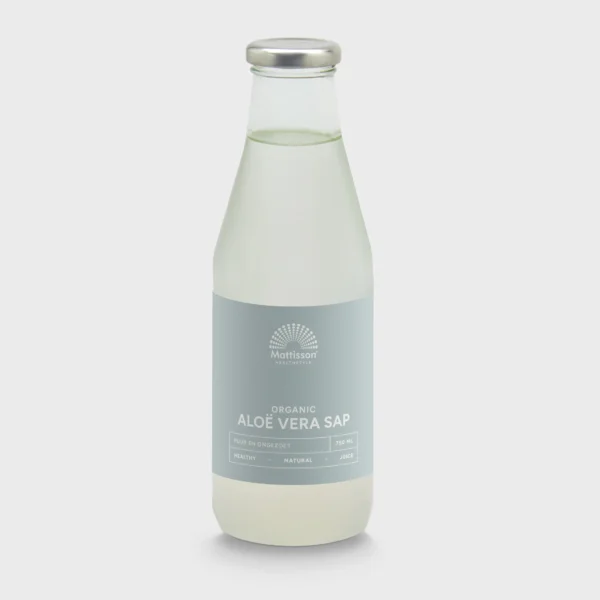
Aloe vera juice has exactly one job when it’s done properly: be aloe, and nothing else. Mattisson’s is 100% pure organic juice pressed from the leaves of Aloe barbadensis Miller — the classic aloe of the tradition — with no added water, sugar, thickeners or preservatives. One ingredient, one 750 ml bottle, organic and vegan.
The plant behind the bottle
Aloe barbadensis is the world’s most cultivated aloe for good reason: its thick, gel-filled leaves have been pressed into juice across North Africa, the Mediterranean and beyond for thousands of years. Malta knows the plant well — half the island grows it on a balcony and swears by it. The juice is the drinkable expression of that same leaf: light, faintly bitter-fresh, unmistakably plant-like in the way genuinely unadulterated juices are.
What “100% pure” rules out
Much commercial aloe drink is aloe-flavoured sugar water — a splash of aloe, a lot of glucose syrup, and a texture engineered with gums. This bottle is the opposite: the ingredient list reads, in full, “100% organic aloe vera juice”. If you’ve only met aloe in sweetened form, expect something cleaner, lighter and more honest — and adjust it to your own taste rather than the manufacturer’s.
How to drink it
Neat — a small measure (a few tablespoons) as the day’s opener, the traditional approach
In water — topped up cold, with lemon if you like; the summer-friendly version
In juice or smoothies — it disappears into orange juice or a green blend while keeping its contribution
In mocktails — with sparkling water, mint and cucumber it earns a place at the table on merit
Use and storage
Shake well before use — a pure juice separates naturally, and that’s a feature. Keep the unopened bottle cool and dark; once opened, refrigerate and treat it like the fresh product it is. As with any concentrated plant food, moderation and common sense apply: start with small measures, and if you are pregnant, breastfeeding or on medication, ask your doctor before making it a daily habit.
Frequently asked questions
Why does it taste different from aloe drinks I’ve had? Because those were mostly sugar. Pure aloe vera juice is light, tart-fresh and distinctly botanical.
Is there pulp in it? Natural sediment and variation are normal in an unprocessed juice — shake and pour.
Vegan and organic? Both, certified — and nothing else in the bottle to complicate the answer.
Choosing an aloe juice worth buying
The aloe aisle rewards label reading more than almost any other. Three checks sort the field: the species (Aloe barbadensis Miller is the classic — it’s on this label), the percentage (100% juice, not “aloe drink” or “with aloe”), and the additive list (here: empty). Organic certification closes the loop, covering how the leaves were grown before they ever met the press. A bottle that passes all four tests doesn’t need marketing adjectives — the ingredient line is the whole pitch, and this one’s ingredient line is seven words long.
Can I cook with it? It’s happiest cold — heat dulls the fresh character; add it to drinks and smoothies rather than the saucepan.
What’s the difference between juice and gel? Gel is the thick leaf interior used topically and in foods as texture; juice is the pressed, drinkable form — this bottle is the latter, made for the glass rather than the skin.
Does organic matter for aloe? Very much — aloe concentrates what it grows in, so certified-organic cultivation is the cleanest guarantee the leaf arrived at the press without a pesticide history.
Delivery in Malta & Gozo
€6 delivery, free over €40 across Malta and Gozo, or collect from our St Paul’s Bay point.
To provide the best experiences, we use technologies like cookies to store and/or access device information. Consenting to these technologies will allow us to process data such as browsing behavior or unique IDs on this site. Not consenting or withdrawing consent, may adversely affect certain features and functions.
Functional
Always active
The technical storage or access is strictly necessary for the legitimate purpose of enabling the use of a specific service explicitly requested by the subscriber or user, or for the sole purpose of carrying out the transmission of a communication over an electronic communications network.
Preferences
The technical storage or access is necessary for the legitimate purpose of storing preferences that are not requested by the subscriber or user.
Statistics
The technical storage or access that is used exclusively for statistical purposes.The technical storage or access that is used exclusively for anonymous statistical purposes. Without a subpoena, voluntary compliance on the part of your Internet Service Provider, or additional records from a third party, information stored or retrieved for this purpose alone cannot usually be used to identify you.
Marketing
The technical storage or access is required to create user profiles to send advertising, or to track the user on a website or across several websites for similar marketing purposes.