



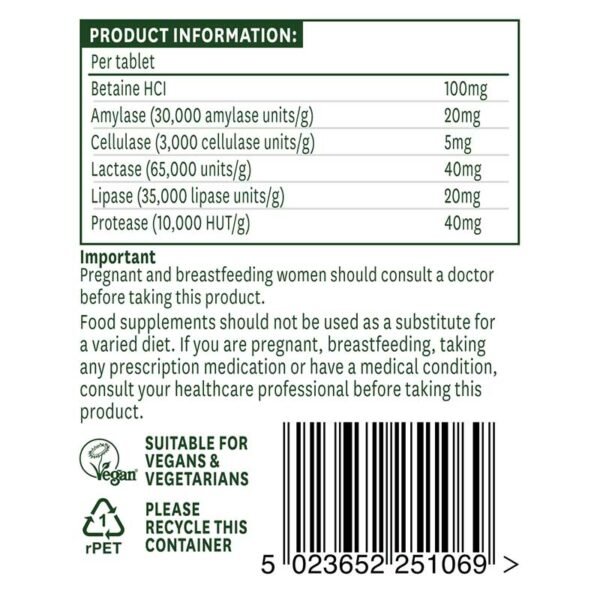

The digestive enzyme complex from Natures Aid assembles five complementary enzymes — amylase for carbohydrates, protease for proteins, lipase for fats, lactase for milk sugar and cellulase for plant fibre — with betaine hydrochloride alongside, in a 60-tablet pack built around the simple premise that the body’s own enzyme output isn’t always at its best.
Why enzyme levels wander
Digestive enzymes are how food becomes nutrition — the molecular scissors for every macronutrient on the plate — and the body’s production of them shifts with age and illness. Supplemental enzymes exist to top up that toolkit at mealtimes: the same enzyme classes physiology already uses, taken with the plates that need them most. The lactase line explains its own following — it’s the enzyme those who struggle with dairy’s lactose reach for by name.
The five-plus-one lineup
- Amylase — starches and carbohydrates
- Protease — proteins
- Lipase — fats
- Lactase — lactose, dairy’s famous troublemaker
- Cellulase — plant cell walls, the fibre-heavy plate’s assistant
- Betaine HCl — the classical acidity companion of enzyme formulas
An allergen note we insist on making
Read this if you avoid wheat or soya: the enzyme preparations in this formula are declared as products of wheat (protease, lactase) and soya (lactase, amylase, lipase) on the ingredient list. The enzymes themselves are plant-sourced and the tablet suits vegetarian and vegan diets — but coeliac and soya-allergic customers should treat those “product of” declarations seriously and consult the pack label or their doctor before use. We’d rather flag it twice than have you find it once.
How to take it
One to two tablets per day at mealtimes — enzymes work where the food is, so timing is the whole technique. Do not exceed the intake. Persistent digestive symptoms are a doctor’s question, not a supplement decision; pregnancy and medication carry the usual professional-advice rule.
Frequently asked questions
Which meals deserve the tablet? The biggest and the trickiest — the holiday dinner, the cheese board, the fibre-heavy experiment.
Daily or occasional? The label allows either rhythm; many keep it as an as-needed table companion.
With the live-culture capsule? Different tools, same toolbox — enzymes at meals, cultures at breakfast; our Gut & Digestion Bundle packages exactly that logic.
Enzymes at the Maltese table
If any nation’s eating was designed to test digestion, it’s festive Malta: the fenkata, the wedding buffet, the Christmas run of qagħaq and cheese — meals whose ambitions regularly outpace anyone’s enzyme output. That’s the honest slot for a mealtime complex: not as daily crutch but as table equipment for the plates that deserve respect, kept in the drawer where the good napkins live. The technique bears repeating because it is the whole product: with the meal, not after the regret — enzymes work on contact, and a tablet swallowed at dessert missed the appointment. Pair the habit with slower forks and the formula gets to look its best.
Betaine HCl’s role? The traditional acidity companion — formulas have paired it with enzymes for decades on the logic that digestion begins in an acid bath.
Can I take it with antacids? The two philosophies argue — sequence them with your pharmacist rather than guessing.
Two months per pack? At the as-needed rhythm most households keep, comfortably — daily users at two tablets get a clean month.
Vegan despite the wheat/soya note? Yes — “product of” declares the enzymes’ growth substrate, not animal inputs; the diet suitability and the allergen caution are separate facts, both true.
Store them where? The dining-room drawer beats the medicine cabinet — mealtime products live where meals happen.
Delivery in Malta & Gozo
€6 delivery, free over €40 across Malta and Gozo, or collection from St Paul’s Bay.








Reviews
There are no reviews yet.