

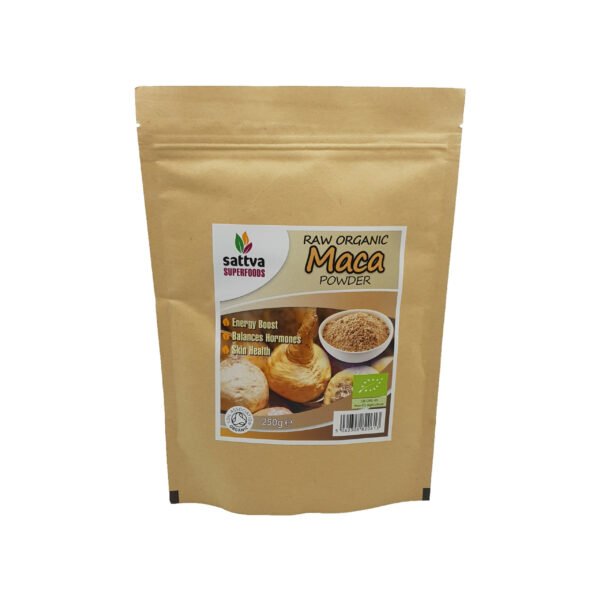
Maca powder is the ground root of Lepidium meyenii — the hardy cruciferous plant that grows where almost nothing else will, on Peru’s Junín plateau at over 4,000 metres. Andean communities have cultivated and eaten it for some two thousand years, first as a storable staple food and then as the prized root that travelled down from the mountains. Sattva Superfoods’ maca is certified organic, single-ingredient, grown in Peru where the plant belongs, and packed in the UK in a 250 g resealable pouch.
A root, first and always
It helps to remember maca is a food before it is a trend: a relative of radish and cress, traditionally dried and ground into flour for porridges, breads and the roasted-grain drink maca de coca. The flavour reflects that heritage — earthy, malty, faintly butterscotch — which is why maca slipped so naturally into modern smoothie and baking culture; it tastes like an ingredient, not a supplement.
Yellow, red or black?
Maca roots grow in a colour range, and tradition sorts them: yellow maca — this pouch — is the most abundant and the everyday culinary standard; darker roots are scarcer and traditionally kept for their own uses. If you’re curious about the rarer end of the spectrum, our black maca powder sits one shelf over — many maca drinkers keep both and alternate.
How to use it
- Smoothies — a teaspoon with banana, dates and nut milk; maca’s malty side loves anything caramel-adjacent
- Porridge and overnight oats — stirred in with cinnamon, the closest thing to its traditional preparation
- Maca latte — whisked into warm milk with honey and cinnamon; a caffeine-free morning ritual
- Baking — a spoonful in flapjacks, energy balls and banana bread adds a butterscotch depth sugar can’t fake
- Coffee’s companion — a pinch in the grounds or the cup rounds bitter coffee remarkably well
An honest word on flavour and pace
Maca tastes pleasantly odd on first meeting — malt, earth and a whisper of radish heritage. In sweet, creamy company it is entirely at home. The customary culinary serving is a teaspoon (about 3–5 g); the traditional Andean approach is regular and moderate, and the 250 g pouch supports months of exactly that.
Frequently asked questions
Raw or gelatinised? This is raw maca powder — the whole dried root, milled, in keeping with the raw-food standard of the Sattva Superfoods range.
Caffeine? None — maca lattes earn their morning slot on flavour alone.
Storage? Cool, dry, resealed; treated like flour it keeps happily for many months.
From the Junín plateau to the pantry
Maca’s home ground is agricultural extremity: frost most nights, fierce UV by day, thin air and thinner soil at altitudes where even potatoes surrender. The root survives by storing everything it can below ground, and Andean farming has worked that endurance for millennia — traditionally the harvested roots are even sun-dried at altitude before milling, an unhurried process the modern organic supply chain preserves. That hard-country biography is why the powder in this pouch is dense, storable and calorific in the old-fashioned, useful sense: it was a survival food long before it was a smoothie ingredient.
Three easy ways to start tonight
The caramel smoothie: banana, two dates, a teaspoon of maca, nut milk and ice — the recipe that converts most first-timers, because maca and dates share a butterscotch register. Maca hot cacao: half a teaspoon each of maca and cocoa powder whisked into hot milk; the malt rounds the chocolate beautifully. Upgraded flapjacks: a tablespoon in the next oat-and-honey tray bake, where it reads as brown-sugar depth. None demand new equipment or new habits — the best superfoods slot into the kitchen you already run.
Delivery in Malta & Gozo
€6 delivery, free over €40 across Malta and Gozo, or collection from St Paul’s Bay.

Reviews
There are no reviews yet.