

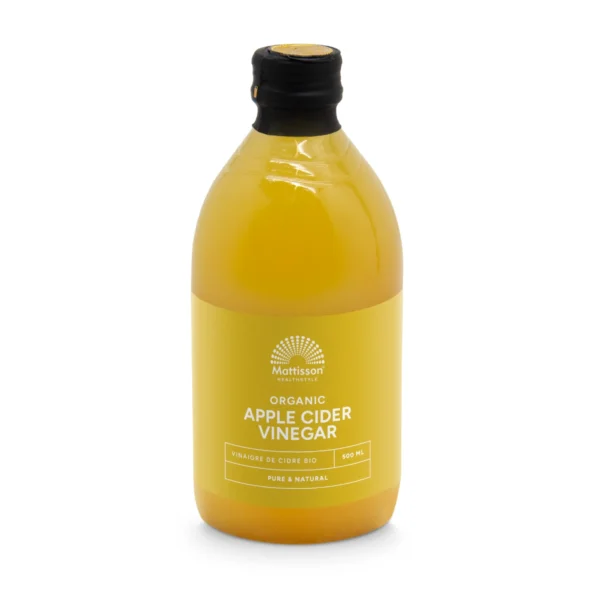
Real apple cider vinegar — the raw, cloudy kind with ‘the mother’ drifting in the bottle — is a different product from the clear supermarket stuff, and Mattisson’s is the genuine article: organically grown apples, naturally fermented, unfiltered and unpasteurised into a golden 500 ml bottle with exactly one ingredient.
What makes it “with the mother”
Apple cider vinegar is made in two fermentations: apple sugars become alcohol, and acetic-acid bacteria then turn that alcohol into vinegar. Filter and pasteurise the result and you get glass-clear vinegar; leave it raw, as Mattisson does, and it keeps the strands of the culture that did the work — ‘the mother’. The cloudiness is the point: it is the visible signature of an unfiltered, traditionally made vinegar, and shaking the bottle gently before use redistributes it.
In the kitchen and beyond
- The morning ritual — one to two tablespoons diluted in a large glass of water, the classic way to take it
- Vinaigrettes — brighter and fruitier than wine vinegar; superb with olive oil, mustard and honey
- Marinades and pickles — the acidity tenderises and preserves
- Baking — a spoonful with bicarbonate of soda is the old trick for lift in egg-free bakes
- Hair rinse — the traditional external use: diluted, as a clarifying final rinse
How to start
Begin cautiously — a teaspoon in a full glass of water — and build to one or two tablespoons daily as it suits you. Always dilute it: neat vinegar is harsh on tooth enamel and throat. Many people drink it through a straw and rinse with plain water afterwards, which is kind to your teeth and costs nothing. Read the label directions and treat it as what it is: a food, taken sensibly.
| ingredients | 100% Organic Apple Cider Vinegar. |
|---|---|
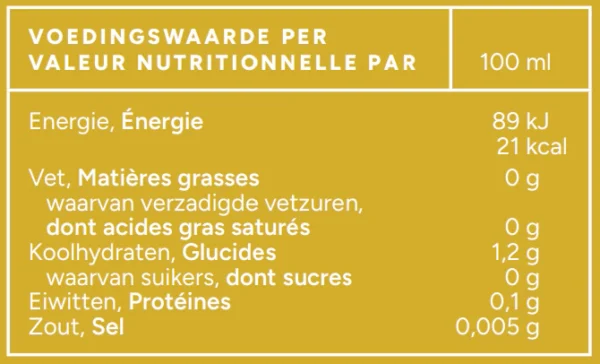
| nutritional value per | 100 ml |
| energy | 89 kJ / 21 kcal |
| fat | 0 g |
| fat of which saturated | 0 g |
| carbohydrates | 1.2 g |
| of which sugars | 0 g |
| proteins | 0.1 g |
| salty | 0.005 g |
Quality and storage
The ingredient list reads, in full: 100% organic apple cider vinegar. No flavourings, no added sulphites, no artificial anything. Store it cool and out of direct sunlight; once opened, Mattisson recommends refrigerating and using within about two months. Sediment settling between uses is natural — that’s the mother, doing what mothers do.
Frequently asked questions
Why is my bottle cloudy? Because it’s unfiltered — that haze is the culture strands, the mark of raw vinegar. Shake gently before pouring.
Does it need refrigeration before opening? No — a cool cupboard is fine until the seal is broken.
Can I cook with it? Absolutely, though heat is wasted on the mother — for raw-vinegar purists, save it for dressings and cold uses and cook with cheaper vinegar.
Why organic matters in a vinegar
Vinegar concentrates what the fruit brings, so the orchard’s practices travel into the bottle with it. Organically grown apples mean the fermentation starts from clean raw material — no synthetic pesticide residues along for the ride — and with a single-ingredient product there is nowhere for shortcuts to hide. It’s also why a good organic ACV tastes distinctly of apples rather than merely of acid: the fruit was the whole recipe. Once you’ve dressed a tomato salad with the raw, mother-in kind, the clear stuff starts tasting like what it is — a solvent with a certificate.
Is it suitable for fasting routines? A splash in water contains next to nothing caloric — check the nutrition table above and decide by your own protocol’s rules.
Delivery in Malta & Gozo
€6 delivery, free over €40 across Malta and Gozo, or collect at St Paul’s Bay. It’s a cornerstone of our Gut & Digestion Bundle too, if you’d rather take the 10% saving.



Reviews
There are no reviews yet.