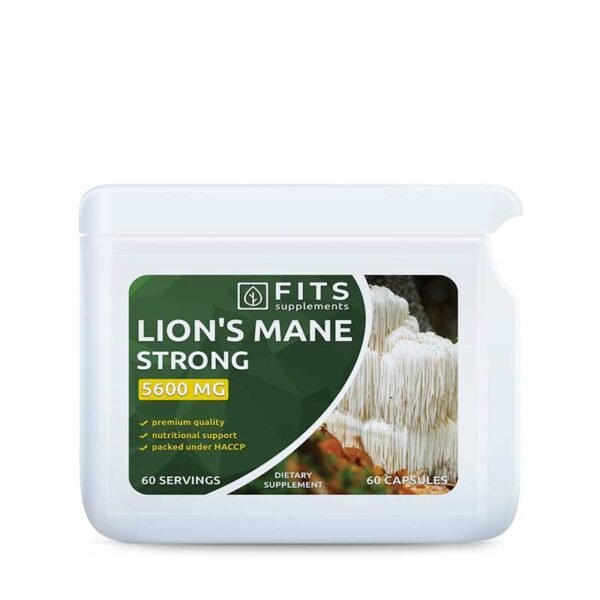
Lions Mane — the shaggy white mushroom the Chinese tradition calls hóu tóu gū and Japan calls yamabushitake — has gone from monastery kitchens to modern morning routines faster than any fungus in memory. Fits’ Strong formula delivers it at serious concentration: the equivalent of 5600 mg of Lion’s Mane per serving, from organically cultivated, fermented mycelium, in vegetarian capsules.
The mushroom with a millennium of admirers
Hericium erinaceus is unmistakable in the wild — a cascade of white icicle-like spines on hardwood trunks — and unmistakable in tradition, where East Asian herbal practice prized it for centuries and Buddhist mountain monks lent it its Japanese name. Modern wellness culture adopted it as the thinking person’s mushroom, and it now anchors more morning routines than any botanical of its generation.
How this version is grown
Fits cultivates the mycelium — the fungus’s living root network — on organic, gluten-free whole oats, then ferments it, a method that yields a consistent, food-grade material at meaningful strength. The result is non-GMO, gluten-free and vegetarian throughout, with the 5600 mg equivalence stated plainly on the label. (Mushroom purists debate mycelium versus fruiting-body preparations with theological intensity; our shelf carries both schools — this is the fermented-mycelium representative, priced accordingly.)
How to take it
Take as directed on the pack, with food — mornings with coffee is the culture’s favourite pairing. Do not exceed the stated dose. Not recommended during pregnancy or breastfeeding without medical advice; the same professional conversation applies if you take medication. Food supplements complement a varied, balanced diet.
Who takes lions mane?
Students and knowledge workers who arrived via the focus-culture podcasts; mushroom-curious customers starting with the category’s most famous name; and stack-builders pairing it with ashwagandha and magnesium in the modern foundations trio — the combination our Wellness Bundle boxes ready-made.
Frequently asked questions
Capsules or the culinary mushroom? Both are legitimate — the capsule concentrates and standardises what the sauté pan can’t; the fresh mushroom remains delicious on its own merits.
Morning or evening? Tradition and habit both favour mornings; it contains no caffeine either way.
The “5600 mg equivalent” line deserves translation: extract-and-concentration arithmetic means each serving represents that weight of source material, not that the capsule physically contains 5.6 grams. It’s the same convention the whole botanical industry uses, and it’s why comparing mushroom products on capsule size alone misleads — the equivalence figure and the growing method are the two numbers that matter. Fits states both, which puts this label in the more honest half of a famously murky category. Run it like the tradition ran it: daily, with food, judged across a season — mushrooms have never been in a hurry and see no reason you should be.
Does it taste of mushroom? Capsules spare you entirely — the flavour experience belongs to the broth and the frying pan.
Why do people type “lions mane” without the apostrophe? Search habits — the mushroom answers to both spellings, and so does this page.
Gluten status, given the oats? The label declares gluten-free — the cultivation uses certified gluten-free whole oats, tested accordingly.
Pairing with coffee — why the tradition? The modern mushroom-coffee wave made the two inseparable; practically, it just anchors the capsule to the day’s most reliable ritual.
Reorder rhythm? Check your pack’s serving count against the daily dose and reorder at the final quarter — mushroom routines resent gaps more than most.
Delivery in Malta & Gozo
€6 delivery, free over €40 across Malta and Gozo, or collection from St Paul’s Bay.
To provide the best experiences, we use technologies like cookies to store and/or access device information. Consenting to these technologies will allow us to process data such as browsing behavior or unique IDs on this site. Not consenting or withdrawing consent, may adversely affect certain features and functions.
Functional
Always active
The technical storage or access is strictly necessary for the legitimate purpose of enabling the use of a specific service explicitly requested by the subscriber or user, or for the sole purpose of carrying out the transmission of a communication over an electronic communications network.
Preferences
The technical storage or access is necessary for the legitimate purpose of storing preferences that are not requested by the subscriber or user.
Statistics
The technical storage or access that is used exclusively for statistical purposes.The technical storage or access that is used exclusively for anonymous statistical purposes. Without a subpoena, voluntary compliance on the part of your Internet Service Provider, or additional records from a third party, information stored or retrieved for this purpose alone cannot usually be used to identify you.
Marketing
The technical storage or access is required to create user profiles to send advertising, or to track the user on a website or across several websites for similar marketing purposes.