
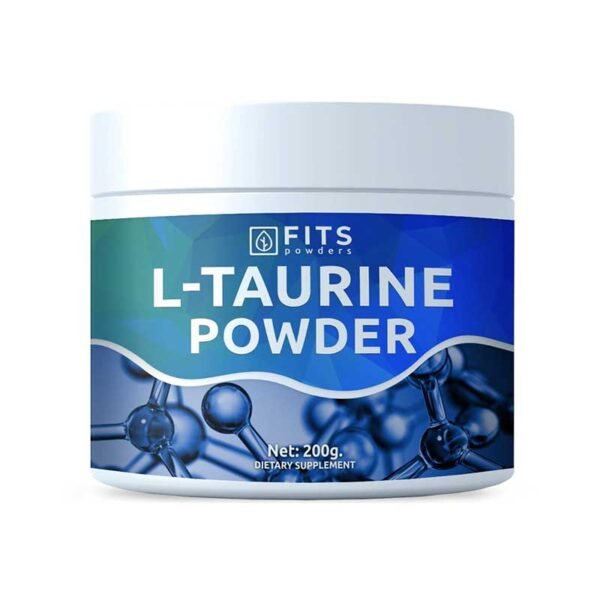
L-taurine occupies a curious corner of the amino acid family: technically not a protein-builder at all, but a free-standing amino acid the body keeps in meaningful quantities in muscle, heart and brain tissue — produced internally in modest amounts and otherwise sourced from meat, fish and seafood. Fits supplies it the honest way: 200 g of pure single-ingredient powder, nothing else in the pouch.
What taurine is — and isn’t
Taurine’s public reputation was hijacked by energy drinks, so let’s restore the record: the compound itself is a naturally occurring amino acid named after the bull bile it was first isolated from in 1827 (taurus — the branding wrote itself), present across animal tissues and human physiology alike. It contains no caffeine and no stimulant character of its own — the energy-drink association is company it keeps, not chemistry it performs. As a plain powder it is simply one of the sports-nutrition world’s longest-serving single ingredients.
Why plant-based eaters take note
Dietary taurine comes almost exclusively from animal foods — meat, fish, shellfish — which places vegans and vegetarians among the lowest-intake groups. Synthesised supplemental taurine (no animal inputs involved, bulls included) is the standard answer for plant-based athletes who want the compound their diet skips.
What’s in the pouch
100% L-taurine powder — the entire label. It dissolves readily, tastes near-neutral, and disappears into water, juice or the pre-training shake without negotiation. The 200 g pouch runs for months at typical serving sizes.
How to take it
Mix the recommended serving (per the pack) into your drink of choice. Do not exceed the stated dose. Pregnant or breastfeeding women and anyone on medication should have the usual professional conversation first. Food supplements complement a varied, balanced diet.
Who uses taurine powder?
Sports-nutrition regulars building their own pre-workout blends who want ingredients one at a time; plant-based athletes covering the animal-food gap; and label-readers who’d rather buy the compound plain than pay energy-drink prices for it dressed in sugar and neon.
Frequently asked questions
Will it keep me awake? Nothing in taurine is stimulant — the wide-awake reputation belongs entirely to the caffeine it shares cans with.
When do people take it? Pre-training is the classic slot; the DIY-blend crowd doses it alongside their other singles.
Taste? Faintly neutral-sweet — undetectable in anything with actual flavour.
The single-ingredient stack philosophy
Pre-made pre-workouts are recipes you didn’t write: doses hidden in “matrix” blends, stimulants you didn’t order, sweeteners you can’t uninvite. The single-powder approach — taurine here, creatine there, theanine when wanted — rebuilds the recipe under your authorship, at a fraction of the cost per serving and with every gram accountable. Taurine is a natural early hire for that project precisely because it’s so undemanding: neutral taste, easy solubility, decades of sports-nutrition service. Start the DIY blend with the boring reliables and let the exotic ingredients audition later, one at a time, where you can actually hear them.
Does it clump or settle? It dissolves cleanly with a stir — none of creatine’s sediment theatre.
Is synthesised taurine vegan? Yes — modern supplemental taurine is produced without animal inputs, which is precisely what makes it the plant-based athlete’s answer.
How long does 200 g last? Months at standard servings — among the best cost-per-serving items in the sports section.
Shaker or glass? Either — it’s the least demanding powder in the drawer; even a teaspoon and tap water suffice.
Store the pouch how? Sealed, dry, spoon kept out — amino powders live long, unglamorous lives when treated with basic courtesy.
Delivery in Malta & Gozo
€6 delivery, free over €40 across Malta and Gozo, or collection from St Paul’s Bay.