

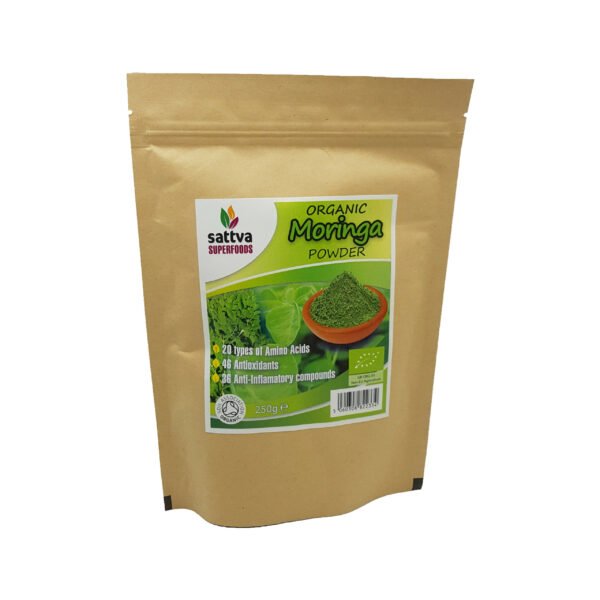
Moringa powder comes from the leaves of Moringa oleifera — the fast-growing tree that South Asian tradition nicknamed the “miracle tree” and modern nutrition simply calls one of the most nutrient-dense leaves ever milled. Sattva Superfoods’ moringa is certified organic, single-ingredient, grown in India where the tree is native, and packed in the UK in a 250 g pouch.
The leaf behind the reputation
Moringa’s standing isn’t a modern invention: the tree has fed Indian, African and Southeast Asian kitchens for centuries — leaves in dals and stews, pods as the “drumsticks” of drumstick curry. What drying does is concentrate the leaf: gram for gram, dried moringa leaf is notably rich in protein (complete, with all essential amino acids), calcium, potassium, iron, and vitamins A, B and C, alongside antioxidant compounds the leaf carries naturally — vitamin C itself, beta-carotene, quercetin and chlorogenic acid among them.
Iron, plainly stated
Among moringa’s minerals, iron deserves the plainest sentence: iron contributes to the reduction of tiredness and fatigue and to normal red blood cell formation — one of nutrition’s officially recognised roles — and dried moringa leaf is a genuinely rich plant source of it. That is the fact, stated at whole-food scale; anyone managing a diagnosed deficiency should be guided by their doctor rather than any powder.
How to use it
- Smoothies — a teaspoon with mango or banana, the classic pairing; moringa’s green is gentler than spirulina’s
- Soups, dals and stews — stirred in at the end, exactly as the fresh leaf is used across India
- Dressings and dips — whisked into tahini or yoghurt with lemon, it reads as a mild herb
- Moringa latte — the matcha-adjacent preparation: a teaspoon whisked into warm milk with honey
- Baking — folded into savoury muffins and flatbreads for colour and depth
An honest word on flavour
Moringa tastes green and lightly peppery — nearer rocket or matcha than grass, and considerably friendlier than most green powders. It behaves like a mild herb in savoury food, which is why it is one of the few superfood powders that genuinely belongs in the dinner rotation as well as the blender.
Frequently asked questions
Moringa vs matcha? Matcha brings caffeine; moringa brings none. Moringa suits evenings and children’s smoothies where matcha doesn’t.
How much per serving? A teaspoon (about 3 g) is the customary culinary measure — the 250 g pouch lasts months.
Storage? Cool, dry and resealed; the greener the powder stays, the fresher it is.
The traditional kitchen, translated
In Tamil Nadu and Kerala, moringa leaves are wilted into dals the way Europeans use spinach; in the Philippines the leaf is malunggay, dropped by the handful into tinola broth; across West Africa it thickens groundnut stews. The dried powder is simply the traveller’s version of that tradition — a spoonful stirred into lentil soup at the end of cooking recreates the original dish with pantry convenience. Treat it like a soft green herb rather than a supplement and it earns a permanent place beside the cumin and the stock cubes.
Reading the label like a nutritionist
Dried leaf powders concentrate everything the fresh leaf holds — that is their point, and also why comparison tables (“more calcium than milk, more iron than spinach”) float around the moringa category. Those comparisons describe the dried leaf gram for gram, and a daily serving is a teaspoon, not a glassful, so the honest framing is simpler: moringa powder is a genuinely dense source of minerals and vitamins for its spoonful, an excellent supporting player in a varied diet rather than a substitute for whole food groups. That is the claim this page makes, and the leaf carries it comfortably.
Delivery in Malta & Gozo
€6 delivery, free over €40 across Malta and Gozo, or collection from St Paul’s Bay.

Reviews
There are no reviews yet.