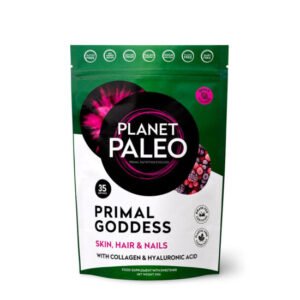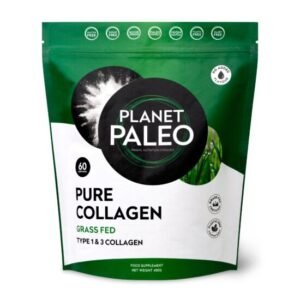

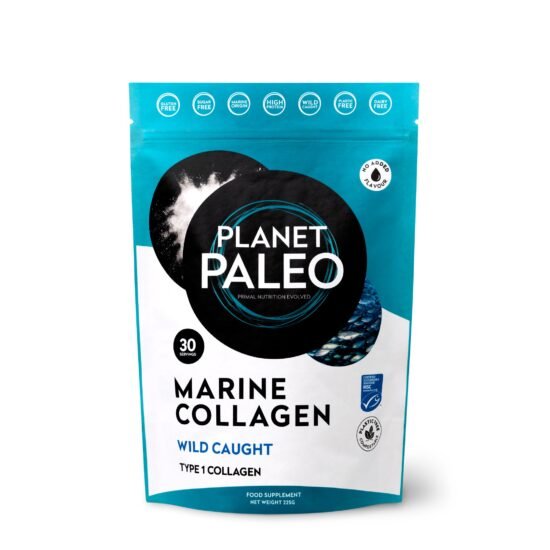
Planet Paleo Marine Collagen is hydrolysed collagen from wild, sustainably caught fish — a single-ingredient powder that dissolves cleanly into hot or cold drinks. For anyone who wants collagen without the bovine route, this is the marine alternative done properly: wild-caught, traceable, and broken down into fine peptides the body can actually absorb.
What hydrolysed marine collagen is
Collagen in its native form is a long, tough structural protein; hydrolysis chops it into short fragments — collagen peptides — that dissolve instantly and digest easily. Planet Paleo’s marine version delivers those peptides from fish skin rather than beef hide, which matters to pescatarians, to anyone avoiding meat, and to drinkers who prefer marine collagen’s famously neutral character in coffee and tea.
The amino-acid picture
Collagen is protein with an unusual profile: notably rich in glycine and proline, the amino acids that are scarce in muscle-meat protein and abundant in the traditional stock-pot foods — skin, bones, broth — that modern diets quietly dropped. A daily serving restores a shot of exactly that old-fashioned protein fraction, stated plainly as composition rather than promises.
How to take it
- Serving — 1 to 1.5 scoops (7.5 g) once or twice daily, with or between meals, per the pack directions
- Hot drinks — stirs invisibly into coffee or ginger tea; marine collagen is the most neutral-tasting of the collagens
- Cold — shaken into at least 200 ml of water or juice, or blended into smoothies
- Food — a scoop in porridge or yoghurt disappears without changing texture
Why wild and sustainable matters
Marine collagen quality tracks its fishery: Planet Paleo sources from wild, sustainably caught fish rather than intensive aquaculture, which is both the cleaner supply chain and the more responsible one. It also makes the powder a use-what’s-there story — collagen-rich fish skin that processing would otherwise discard, turned into the most valuable part of the catch.
Precautions, plainly
Contains fish. If you are pregnant or breastfeeding, consult your healthcare practitioner before use. As with any food supplement, this is an addition to — never a substitute for — a varied, balanced diet and healthy lifestyle.
Frequently asked questions
Marine vs bovine collagen? The peptides are closely similar; the source differs. Marine suits meat-avoiders and mixes with the least flavour of all. Planet Paleo’s grass-fed Pure Collagen is the bovine sibling.
Taste? Effectively none in normal servings — the reason marine collagen conquered the coffee ritual.
Storage? Cool, dry, lid tight; the powder is happily shelf-stable.
Fitting it into training and routine
Collagen’s practical virtue is frictionlessness: it attaches to habits you already have rather than demanding new ones. Coffee drinkers add it to the first cup; gym-goers put it in the post-session shake alongside their usual protein, since collagen’s amino profile complements rather than replaces whey or plant blends; broth traditionalists stir it into evening tea as the modern shortcut to the stock-pot. Consistency beats quantity — the pack’s one-to-two daily servings, kept up quietly for months, is the entire method. The 7.5 g scoop is protein you barely notice taking, which is precisely why people keep taking it.
A note on the paleo logic
Planet Paleo’s premise is that traditional eating used the whole animal — skin, bones and connective tissue included — and modern eating quietly stopped. Collagen peptides are that missing fraction returned in measurable form: nose-to-tail eating for people whose kitchens no longer run to fish-head broth, wild-caught and hydrolysed so the old food fits the new routine.
Choosing a marine collagen well
Three questions sort the category: is the fish wild or farmed, is the collagen fully hydrolysed, and is the ingredient list exactly one line long? This tub answers wild, yes, and yes — which is the whole audit.
Delivery in Malta & Gozo
€6 delivery, free over €40 across Malta and Gozo, or collection from St Paul’s Bay.