
Ashwagandha in Malta: KSM-66 and How to Read the Label (2026 Guide)

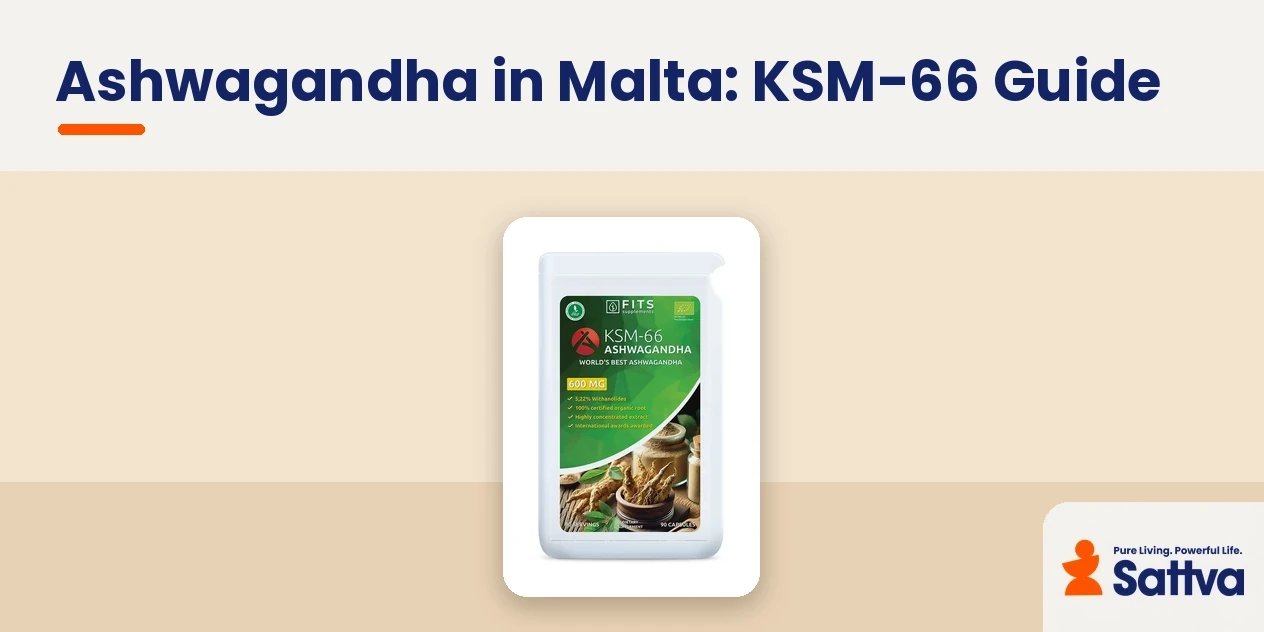
Ashwagandha has gone from Ayurvedic tradition to one of the most searched supplements in Malta — and with that popularity has come a flood of products that look identical on the shelf but differ enormously on the label. This guide shows you exactly what to check before you buy, and where to find a fully disclosed, organic option stocked locally at Sattva Health Shop.
As always on this blog: we don’t make medical claims, and a trustworthy label doesn’t either. What a good label does tell you is what’s in the capsule, in what form, at what dose — and that’s where almost all of the quality difference between ashwagandha products lives.
What ashwagandha actually is
Ashwagandha (Withania somnifera) is a shrub whose root has been used in Ayurveda for centuries. Modern supplements use a concentrated extract of the plant, usually standardised to its naturally occurring compounds called withanolides. Two products both saying “ashwagandha 600 mg” can contain very different things: one might be simple ground root powder, the other a standardised extract many times more concentrated.
The four things to check on an ashwagandha label
- Root-only or whole plant? Traditional use and most modern research centre on the root. Cheaper products pad the capsule with leaf and stem. The label should say “root extract”.
- Is it a branded, standardised extract? Branded extracts like KSM-66 publish their standardisation — KSM-66 is a root-only extract standardised to withanolide content, and it’s the most studied ashwagandha extract on the market. A label that names its extract is making a verifiable statement; “ashwagandha extract” alone is not.
- The actual dose per capsule. Look for the milligrams of extract per capsule on the front, not buried in a footnote — and check how many capsules that dose assumes.
- Organic certification. Ashwagandha is a root crop, so how it’s grown matters. A genuine organic certification is printed on the label with a certifying body’s code.
Our stocked pick: Fits Organic KSM-66, 600 mg
Fits Organic KSM-66 Ashwagandha 600 mg ticks every box above: the branded KSM-66 root-only extract, organic, 600 mg per capsule stated on the front of the label, 90 capsules per pot. It’s the ashwagandha we reach for when customers ask where to start, because everything you’d want to verify is printed where you can see it.
How people take it
Most labels suggest one capsule daily with food, and consistency matters more than timing — ashwagandha is typically taken as a daily habit over weeks rather than as a one-off. Check your own product’s label for its directions, and start with the stated serving rather than more.
Pairing it with other adaptogens
Ashwagandha sits in a wider family of adaptogens and functional mushrooms. If you’re exploring the category, Fits Lion’s Mane Strong applies the same label philosophy to the most popular mushroom extract, and the full adaptogens and mushrooms range covers reishi and friends. If you’d rather browse by what you’re working on, start from our goals categories.
Buying ashwagandha in Malta: the practical part
Delivery: orders ship across Malta and Gozo for €6, free on orders over €40, typically within 1–3 working days — or collect from St Paul’s Bay by appointment.
Labels before you buy: every product page on our site lists the full ingredients, extract type and dose, so you can run the four checks above before anything arrives.
Not sure where to start? See what other Malta customers pick in our best sellers.
FAQ
What does KSM-66 mean on an ashwagandha label? It’s the brand name of a specific root-only ashwagandha extract, standardised to withanolide content — naming it lets you verify exactly what’s in the capsule, unlike a generic “ashwagandha extract”.
Where can I buy ashwagandha in Malta? Locally stocked online shops like Sattva deliver across Malta and Gozo from local stock, so you can check the full label on the product page first — no customs or international shipping.
Is ashwagandha suitable for everyone? No supplement is. If you take medication, are pregnant or breastfeeding, or have a health condition, speak with your doctor or pharmacist before adding ashwagandha. Supplements are not a substitute for a varied diet.